
Leveraging AI for Smarter Inbound Marketing (Part 3): From Automation to Intelligence
Learn how AI helps marketers make better decisions, understand the complete customer journey, and prove marketing's business impact.

Sai Sabiksha
Founder
For many marketing teams, launching a campaign is only half the challenge.
The bigger question comes afterward:
Did it actually work?
Imagine you're running three marketing campaigns simultaneously:
- A LinkedIn campaign promoting an eBook.
- A Google Ads campaign driving demo requests.
- An email campaign nurturing existing leads.
After a month, your CEO asks a simple question:
"Which campaign generated the most revenue?"
At first glance, the answer seems straightforward.
You open Google Analytics.
Then your CRM.
Then your email platform.
Then your advertising dashboard.
Suddenly, you're comparing data from four different systems, each measuring success differently.
One platform tells you how many people clicked.
Another tells you how many downloaded your guide.
A third shows email open rates.
Your CRM shows closed deals.
But none of them clearly explain how all those interactions worked together to convert a customer.
This has been one of the biggest challenges in inbound marketing.
Artificial Intelligence is changing that.
Instead of collecting data from multiple disconnected tools, AI brings everything together, helping marketers understand not just what happened, but why it happened.
Marketing Analytics Is No Longer About Numbers—It's About Insights
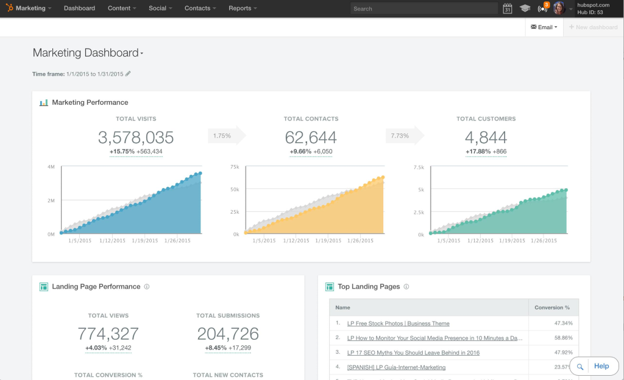
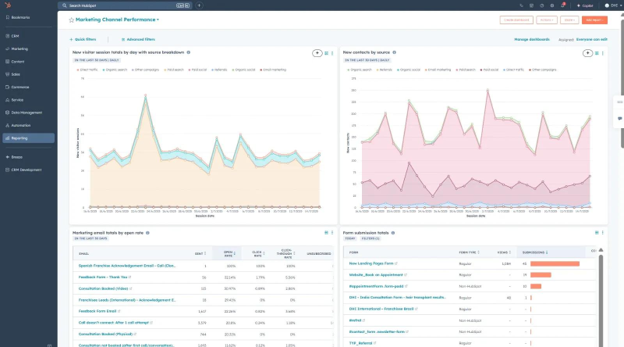
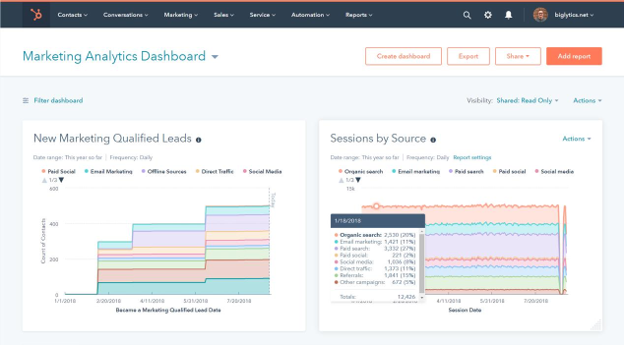
A decade ago, marketing reports focused on simple metrics:
- Website traffic
- Email open rates
- Social media followers
- Ad impressions
While these numbers were useful, they rarely answered the questions business leaders actually cared about.
Questions like:
- Which campaign generated revenue?
- Which content convinced customers to buy?
- Which marketing channel deserves more investment?
- Where are potential customers dropping out of the buying journey?
This is where AI-powered marketing analytics creates a significant advantage.
Instead of displaying hundreds of disconnected metrics, AI identifies patterns, highlights opportunities, and recommends actions marketers can take to improve performance.
Rather than spending hours building reports, marketing teams spend more time making informed decisions.
Understanding the Complete Customer Journey
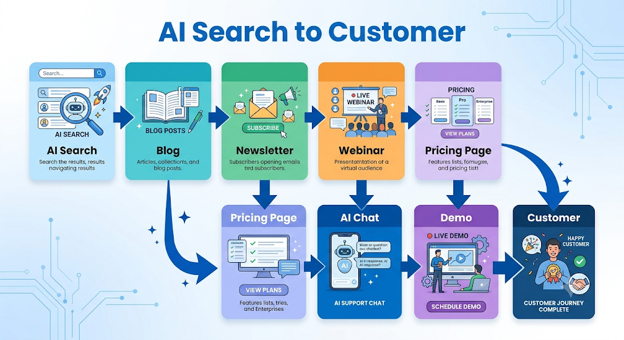
Very few customers purchase a product after just one interaction.
A typical B2B buying journey might look like this:
- A prospect discovers your brand through an AI-generated search result.
- They read one of your blog articles.
- A week later, they download an industry report.
- They subscribe to your newsletter.
- They attend a webinar.
- They revisit your pricing page.
- They chat with an AI customer agent.
- Finally, they schedule a product demo.
Now imagine trying to determine which of these interactions actually influenced the purchase.
Was it the blog?
The webinar?
The email?
The chatbot?
The pricing page?
Traditional analytics often credit only the last interaction, ignoring everything that happened before.
AI takes a different approach.
It connects every touchpoint into a complete customer journey, helping marketers understand how different channels work together to drive conversions.
This provides a much clearer picture of customer behavior and enables businesses to make smarter marketing investments.
Customer Journey Analytics: Seeing What Humans Often Miss
One of the most valuable capabilities of AI is its ability to recognize patterns within large amounts of data.
Imagine two visitors arrive on your website.
Visitor A
- Reads one blog.
- Leaves after two minutes.
- Never returns.
Visitor B
- Reads three articles.
- Downloads an eBook.
- Opens every email.
- Visits the pricing page twice.
- Starts a live chat.
Without AI, these visitors might simply appear as website traffic.
AI recognizes something much more important.
Visitor B is demonstrating strong buying intent.
Rather than waiting for a sales representative to notice this manually, AI automatically identifies high-intent behavior and helps marketing and sales teams prioritize that opportunity.
This kind of behavioral intelligence allows businesses to engage potential customers at exactly the right moment.
Measuring ROI with AI: Proving Marketing's Business Impact
Marketing teams are under increasing pressure to demonstrate measurable results.
Executives no longer ask:
"How many emails did we send?"
Instead, they ask:
- How much revenue did marketing generate?
- Which campaigns produced qualified leads?
- Which channels deserve more budget?
- What should we stop doing?
AI-powered reporting helps answer these questions with greater accuracy.
Modern marketing platforms analyze customer interactions across multiple channels and connect marketing activities directly to business outcomes.
Instead of simply reporting that an email campaign achieved a 30% open rate, AI can help identify whether that campaign influenced pipeline growth, customer acquisition, or revenue generation.
This allows marketing teams to move beyond vanity metrics and focus on meaningful business impact.
Learning from HubSpot: AI-Powered Reporting in Action
One reason HubSpot continues to be a leader in inbound marketing is its focus on connecting marketing activities with measurable business outcomes.
Rather than offering isolated reporting tools, HubSpot Marketing Hub integrates analytics throughout the marketing workflow.
Some of the capabilities include:
Marketing Analytics
Provides centralized dashboards that help teams monitor campaign performance, lead generation, and customer engagement without switching between multiple tools.
Advanced Marketing Reporting
Enables marketers to understand how different campaigns contribute to revenue through multi-touch attribution and customer journey analysis.
Dashboards and Reporting
Transforms complex marketing data into visual reports that executives and marketing teams can easily interpret.
Pathfinder
One of the more innovative capabilities, Pathfinder helps marketers visualize customer journeys, showing where visitors engage most and where they leave the buying process.
Instead of guessing why conversion rates are dropping, businesses can identify friction points and optimize the customer experience.
Together, these capabilities demonstrate how AI can help marketing teams shift from reporting historical performance to continuously improving future results.
Real Results: What AI-Powered Marketing Looks Like
Technology matters only if it creates measurable business value.
According to customer success stories shared by HubSpot, organizations using Marketing Hub have reported impressive improvements after implementing AI-powered marketing capabilities:
- 167% increase in website traffic after six months
- 3× increase in inbound leads
- 83% of users reported improved conversion rates
These figures don't suggest that AI alone guarantees success.
Instead, they highlight what becomes possible when businesses combine intelligent automation, high-quality content, customer data, and strategic marketing execution.
The common thread across these success stories isn't simply adopting AI—it's using AI to create better customer experiences.
What Every Business Can Learn from HubSpot's AI Strategy
Whether you're a startup, a growing SaaS company, or an established enterprise, there are several lessons worth taking from HubSpot's approach.
Focus on Customer Intent, Not Just Traffic
Generating thousands of website visitors means little if those visitors never become customers.
Understanding why people visit your website—and what they hope to accomplish—is far more valuable than simply increasing traffic numbers.
Personalization Builds Better Relationships
Customers are far more likely to engage with businesses that understand their needs.
AI enables organizations to personalize emails, landing pages, content recommendations, and customer interactions without dramatically increasing workload.
Automation Should Support People, Not Replace Them
The goal of AI isn't to eliminate marketers.
It's to remove repetitive tasks so marketers can spend more time creating valuable content, developing strategy, and building stronger customer relationships.
Data Should Drive Decisions
Every marketing campaign generates valuable insights.
Businesses that use AI to analyze those insights can continuously improve their campaigns instead of relying on assumptions or guesswork.
Coming Up in Part 4
In the final section, we'll explore the future of AI-powered inbound marketing and answer one important question:
What should businesses do today to stay competitive tomorrow?
We'll discuss:
- Emerging AI marketing trends
- The rise of AI agents
- Hyper-personalization
- A practical AI adoption roadmap
- Common implementation mistakes
- SyncTechn's perspective on building AI-driven customer experiences
- A powerful conclusion that ties the entire article together
Ready to translate these insights into real operational efficiency?
Let's design and build your custom web applications, SaaS dashboards, or CRM integrations. Reach out to our solutions architect desk for a free feasibility review.