
The ROI of Modern Web Development: Why Investing in a High-Performance Website Pays Off in 2026
Discover how modern web development improves conversions, SEO, customer experience, and revenue. Learn why investing in a high-performance website delivers long-term ROI for your business.

Sai Sabiksha
Web Development & Digital Transformation Experts
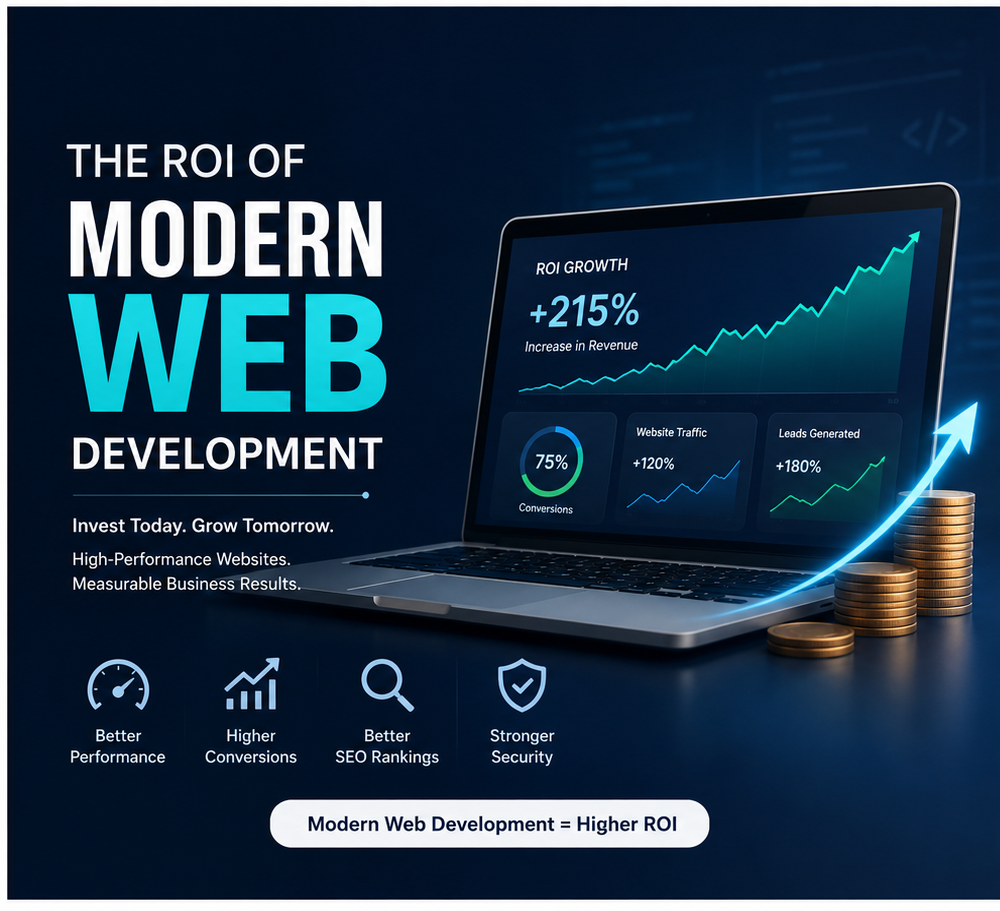
In today's digital-first economy, your website is far more than an online brochure—it's your most valuable business asset. Whether you're a startup, a growing enterprise, or an established brand, your website directly influences customer trust, lead generation, sales, and brand reputation.
Yet many businesses still view web development as an expense instead of an investment. The reality is very different. Modern web development delivers measurable returns by improving user experience, increasing conversions, boosting search engine rankings, and reducing long-term maintenance costs. Businesses that invest in modern websites consistently outperform competitors relying on outdated platforms.
Let's explore how modern web development generates real business ROI and why investing in a high-performance website is one of the smartest decisions a company can make in 2026.
What Does ROI Mean in Web Development?
ROI (Return on Investment) measures the value your website generates compared to the money spent building and maintaining it. While many organizations focus only on development costs, successful businesses evaluate how effectively their website contributes to revenue generation, customer acquisition, and long-term growth.
A successful website isn't simply attractive—it should actively support your business objectives. Every visitor interaction should move users closer to becoming customers while strengthening your brand's credibility and improving operational efficiency.
A High-ROI Website Should Help Your Business
- Generate qualified leads
- Increase online sales
- Improve customer engagement
- Reduce operational costs
- Build brand credibility
- Strengthen customer trust
- Improve marketing performance
- Support long-term business growth
The more efficiently your website helps achieve these goals, the greater your return on investment. Modern development focuses on creating measurable business value rather than simply delivering an attractive interface.
Why Traditional Websites No Longer Deliver Results
Many businesses continue to rely on websites built five or even ten years ago. While these websites may still function, they often struggle to meet today's user expectations and search engine requirements. As digital experiences evolve, outdated websites gradually lose their ability to attract, engage, and convert visitors.
Modern users expect websites to load within seconds, adapt perfectly to mobile devices, and provide seamless navigation. If a website feels slow, confusing, or outdated, visitors are likely to leave before exploring your products or services.
Common Problems Found in Older Websites
- Slow loading speed
- Poor mobile responsiveness
- Outdated user interface
- Weak cybersecurity
- Poor SEO architecture
- Complicated content management
- Limited scalability
- Low conversion rates
Each of these issues directly impacts business performance. Slow websites increase bounce rates, poor navigation frustrates users, weak SEO reduces visibility, and outdated security practices expose businesses to unnecessary risks.
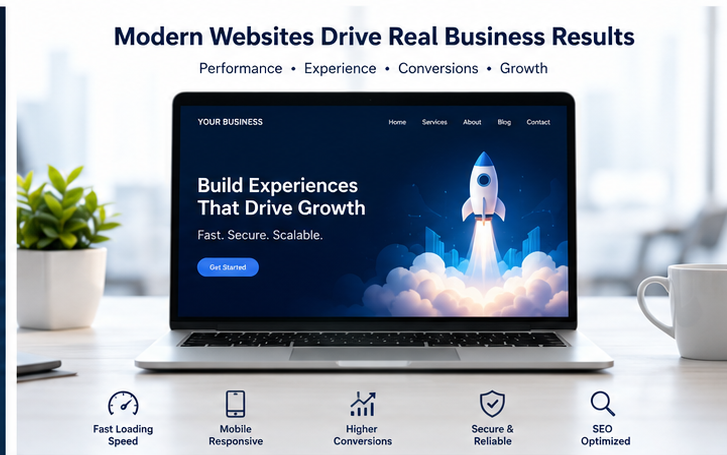
Modern websites outperform traditional websites through faster performance, stronger security, responsive design, and improved user experience.
How Modern Web Development Increases ROI
Modern web development goes far beyond aesthetics. Every technical improvement—from faster loading speeds to stronger security and optimized user experiences—contributes directly to measurable business outcomes. The following factors explain why businesses investing in modern websites consistently achieve higher returns on investment.
1. Faster Website Performance
Website speed directly impacts customer satisfaction, search engine rankings, and revenue. Research consistently shows that users expect websites to load within just a few seconds. Even a small delay can increase bounce rates and reduce conversions.
Modern development practices focus on optimizing every aspect of website performance, ensuring users enjoy a smooth browsing experience regardless of their device or internet connection.
Performance Optimization Techniques
- Image optimization
- Lazy loading
- Code splitting
- Browser caching
- Content Delivery Network (CDN)
- Server-side rendering (SSR)
- Optimized JavaScript
- Modern asset compression
Faster websites improve user engagement, increase conversions, reduce bounce rates, and contribute to better search rankings—making performance optimization one of the highest ROI investments in web development.
2. Better User Experience (UX)
A visually appealing website is valuable only when visitors can easily accomplish their goals. Modern UX design emphasizes simplicity, accessibility, intuitive navigation, and seamless interactions across every device.
Businesses that prioritize user experience encourage visitors to stay longer, explore more pages, and ultimately become paying customers.
Modern UX Best Practices
- Clear navigation
- Responsive layouts
- Logical content structure
- Fast page interactions
- Accessible interfaces
- Consistent branding
- Effective calls-to-action
- Minimal user friction
A positive user experience builds trust, improves customer satisfaction, and significantly increases conversion rates.
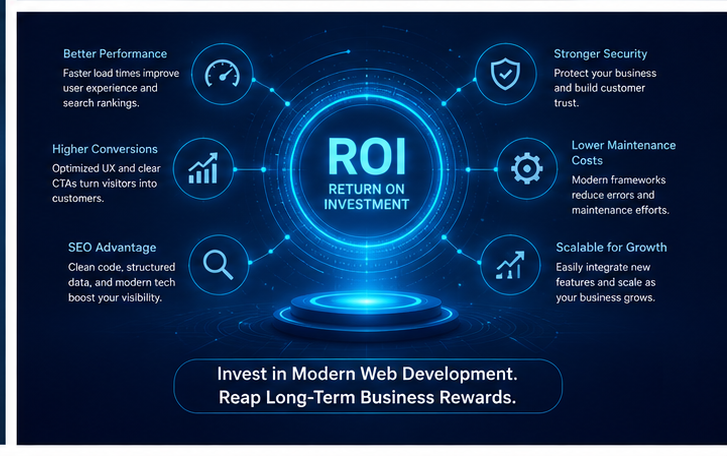
Modern UX design combines responsive layouts, intuitive navigation, and fast interactions to improve customer engagement and conversions.
3. Higher Search Engine Rankings
Search Engine Optimization begins during development. Modern websites are built using SEO-friendly architecture that helps search engines understand content more effectively while providing excellent user experiences.
Clean code, structured data, mobile responsiveness, optimized metadata, and Core Web Vitals all contribute to improved rankings and increased organic traffic.
SEO Features Built into Modern Websites
- Semantic HTML
- Schema Markup
- Core Web Vitals optimization
- Mobile-first architecture
- SEO-friendly URLs
- Internal linking
- Optimized metadata
- Fast page loading
Higher rankings generate sustainable organic traffic, reduce dependence on paid advertising, and improve overall marketing ROI.
4. Improved Mobile Experience
With the majority of internet users browsing on smartphones and tablets, responsive web development has become essential. Modern websites automatically adapt to different screen sizes, ensuring consistent experiences across all devices.
Mobile-friendly websites improve customer satisfaction, increase engagement, reduce bounce rates, and perform better in Google's mobile-first indexing.
Benefits of Responsive Development
- Consistent experience across devices
- Better mobile SEO
- Higher engagement
- Lower bounce rates
- Improved accessibility
- Faster page rendering
- Greater customer satisfaction
- Increased conversions
Responsive design ensures businesses reach customers wherever they are, creating a seamless digital experience across smartphones, tablets, laptops, and desktop computers.
5. Increased Conversion Rates
A high-performing website isn't just about attracting visitors—it's about converting them into customers. Modern web development focuses on designing websites around business objectives, ensuring every page encourages users to take meaningful actions.
Through strategic user journeys, optimized calls-to-action, and intuitive layouts, businesses can significantly improve conversion rates while providing better customer experiences.
Ways Modern Websites Improve Conversions
- Optimized call-to-action buttons
- Simplified contact forms
- Faster checkout experiences
- Online appointment scheduling
- Product recommendation systems
- Lead capture forms
- Live chat integration
- Personalized user journeys
Even small improvements in website usability can result in significant increases in sales, qualified leads, and customer engagement, making conversion optimization one of the most valuable investments in web development.
6. Better Website Security
Cybersecurity threats continue to evolve, making secure web development essential for every business. A security breach can damage customer trust, expose sensitive information, and result in financial losses. Modern development incorporates security best practices throughout the Software Development Life Cycle (SDLC).
Essential Security Features
- HTTPS encryption
- Secure authentication
- Role-based access control
- Input validation
- API security
- Data encryption
- Regular software updates
- OWASP security standards
A secure website protects customer data, reduces business risk, and strengthens brand credibility. Businesses that prioritize cybersecurity build greater trust while avoiding costly downtime and compliance issues.

Security-first web development protects customer data while improving trust and long-term business value.
7. Easier Maintenance
Older websites often require expensive manual updates and become increasingly difficult to maintain as technologies evolve. Modern development frameworks emphasize modular architecture, reusable components, and automated deployment processes, reducing maintenance costs over time.
Benefits of Modern Development Architecture
- Reusable components
- Automated deployments
- Version control integration
- Cloud-native hosting
- Modular architecture
- Simplified updates
- Reduced maintenance costs
- Improved developer productivity
Lower maintenance requirements allow businesses to focus on innovation instead of spending excessive time and money maintaining outdated systems.
8. Scalability for Future Growth
Your website should grow alongside your business. Modern web development enables organizations to expand their digital capabilities without rebuilding their platforms from scratch. Scalable architecture allows businesses to introduce new features quickly while maintaining excellent performance.
Features That Can Be Added Easily
- AI chatbots
- CRM integrations
- Payment gateways
- Customer portals
- Appointment booking
- Analytics dashboards
- Inventory management
- E-commerce capabilities
Scalable websites eliminate the need for costly redesigns every few years. Instead, businesses can continuously improve their digital platforms while supporting long-term growth.
Business Benefits of Modern Web Development
| Business Goal | Modern Development Impact |
|---|---|
| Generate More Leads | Higher conversion rates |
| Increase Revenue | Better customer journeys |
| Improve SEO | More organic traffic |
| Build Customer Trust | Professional design & security |
| Reduce Costs | Lower maintenance expenses |
| Scale Business | Future-ready architecture |
| Improve Decision Making | Better analytics & reporting |
Industries Benefiting the Most
Modern web development delivers measurable ROI across nearly every industry by improving customer experiences, streamlining operations, and enabling digital transformation.
| Industry | Business Benefits |
|---|---|
| Healthcare | Appointment booking, patient portals, secure medical records |
| Real Estate | Property search, virtual tours, lead generation |
| E-commerce | Faster checkout, product recommendations, inventory management |
| Manufacturing | Dealer portals, product catalogs, inquiry management |
| Education | Online learning platforms, student portals, course management |
| Professional Services | CRM integration, consultation booking, client dashboards |
Technologies That Maximize Website ROI
Choosing the right technology stack plays a significant role in maximizing the return on investment of a website. Modern frameworks, cloud infrastructure, and development tools enable businesses to deliver faster, more secure, and scalable digital experiences while reducing long-term maintenance costs.
- React.js
- Next.js
- Node.js
- Express.js
- MongoDB
- PostgreSQL
- AWS
- Google Cloud Platform
- Docker
- Kubernetes
- Vercel
- Cloudflare CDN
By selecting modern technologies that support scalability, performance, and security, businesses can future-proof their websites while minimizing technical debt and operational expenses.
How to Measure Website ROI
A successful website should generate measurable business outcomes rather than simply attracting visitors. Tracking the right Key Performance Indicators (KPIs) allows organizations to evaluate whether their web development investment is delivering meaningful returns.
Important Website ROI Metrics
- Organic website traffic
- Lead generation
- Conversion rate
- Bounce rate
- Average session duration
- Customer acquisition cost (CAC)
- Return on advertising spend (ROAS)
- Revenue generated from website visitors
Monitoring these metrics enables businesses to identify opportunities for continuous improvement while ensuring their website contributes directly to long-term growth.
Future-Proofing Your Business Through Modern Web Development
Technology continues to evolve rapidly, and customer expectations rise with every innovation. Businesses that invest in scalable, secure, and high-performance websites are better positioned to adopt emerging technologies such as Artificial Intelligence, automation, personalized user experiences, and advanced analytics without requiring complete platform rebuilds.
Future-ready web development provides the flexibility to integrate new services, launch digital products faster, and adapt to changing market demands while maintaining excellent performance and security.
Conclusion
Modern web development is no longer simply about creating an attractive website. It is a strategic investment that directly influences revenue, customer acquisition, operational efficiency, and long-term business growth. Every improvement in website speed, user experience, security, scalability, and search engine optimization contributes to measurable business value.
Organizations that embrace modern web technologies position themselves ahead of competitors while creating exceptional digital experiences for customers. By investing in high-performance, scalable, and secure websites today, businesses build a strong foundation for sustained growth, improved customer satisfaction, and a significantly higher return on investment in the years ahead.
Ready to translate these insights into real operational efficiency?
Let's design and build your custom web applications, SaaS dashboards, or CRM integrations. Reach out to our solutions architect desk for a free feasibility review.
Frequently Asked Questions
ROI in web development measures the business value generated by a website compared to the cost of designing, developing, maintaining, and improving it. A high-performing website generates more leads, sales, and customer engagement while reducing long-term operational costs.
Modern web development improves ROI through faster website performance, better user experience, stronger SEO, responsive design, improved security, higher conversion rates, and scalable architecture that supports future business growth.
Fast-loading websites improve user satisfaction, reduce bounce rates, increase conversion rates, and help achieve better search engine rankings, all of which contribute directly to higher business revenue.
Businesses should continuously maintain and optimize their websites while considering a major redesign or modernization every three to five years, depending on technological advancements and changing customer expectations.
Popular technologies include React.js, Next.js, Node.js, Express.js, MongoDB, PostgreSQL, AWS, Google Cloud Platform, Docker, Kubernetes, and modern Content Delivery Networks (CDNs) for high performance and scalability.