Custom Software vs SaaS: Which is Best in 2026?
Compare custom software vs SaaS to understand costs, scalability, security, flexibility, and ROI. Discover which solution best fits your business.
Key Takeaway
Custom software provides complete flexibility, scalability, and 100% ownership for businesses with unique workflows, whereas SaaS offers fast deployment and lower upfront costs for standardized processes. Your choice depends entirely on your long-term ROI goals and security requirements.
Definition
Custom software is applications built specifically tailored to a single organization's unique requirements. Software as a Service (SaaS) is a pre-built, cloud-based software product licensed to multiple organizations on a subscription basis.

Sai Sabiksha
Founder
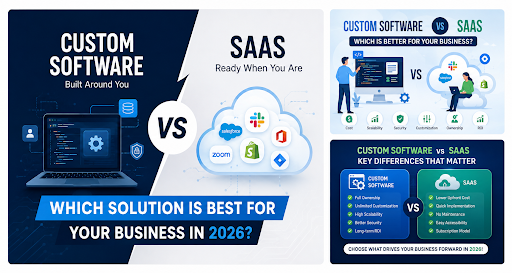
Businesses today have more technology choices than ever before. Whether you're launching a startup, modernizing enterprise operations, or digitizing business processes, one of the biggest decisions you'll face is choosing between Custom Software Development and Software as a Service (SaaS).
While SaaS platforms offer quick deployment and lower upfront costs, custom software provides complete flexibility, ownership, and long-term scalability.
What is Custom Software?
Custom software is a tailored software solution built exclusively to accommodate a specific company's unique business processes, workflows, and operational requirements. Instead of forcing your business to adapt to existing software limitations, custom software is engineered entirely around your goals.
Common examples of custom enterprise applications include:
- Proprietary Enterprise Resource Planning (ERP)
- Custom Customer Relationship Management (CRM)
- Specialized Inventory Management Systems
- HIPAA-compliant Healthcare Platforms
- Automated Manufacturing Software
- Complex Logistics Management Systems
Every feature is tailored to your business objectives. You can explore our comprehensive Custom Software Development services to learn how we build tailored solutions.
What is SaaS (Software as a Service)?
SaaS (Software as a Service) is a cloud-based software delivery model where a third-party vendor develops, hosts, and maintains a standardized application that customers access via the internet on a subscription basis. Popular examples include Salesforce, HubSpot, Slack, and Microsoft 365.
Businesses can start using SaaS almost immediately without custom software development. If you are looking to build a SaaS product, check out our SaaS Product Development services.
In a SaaS model, the software provider manages the servers, databases, infrastructure, security, and feature updates.
Custom Software vs SaaS: Head-to-Head Comparison
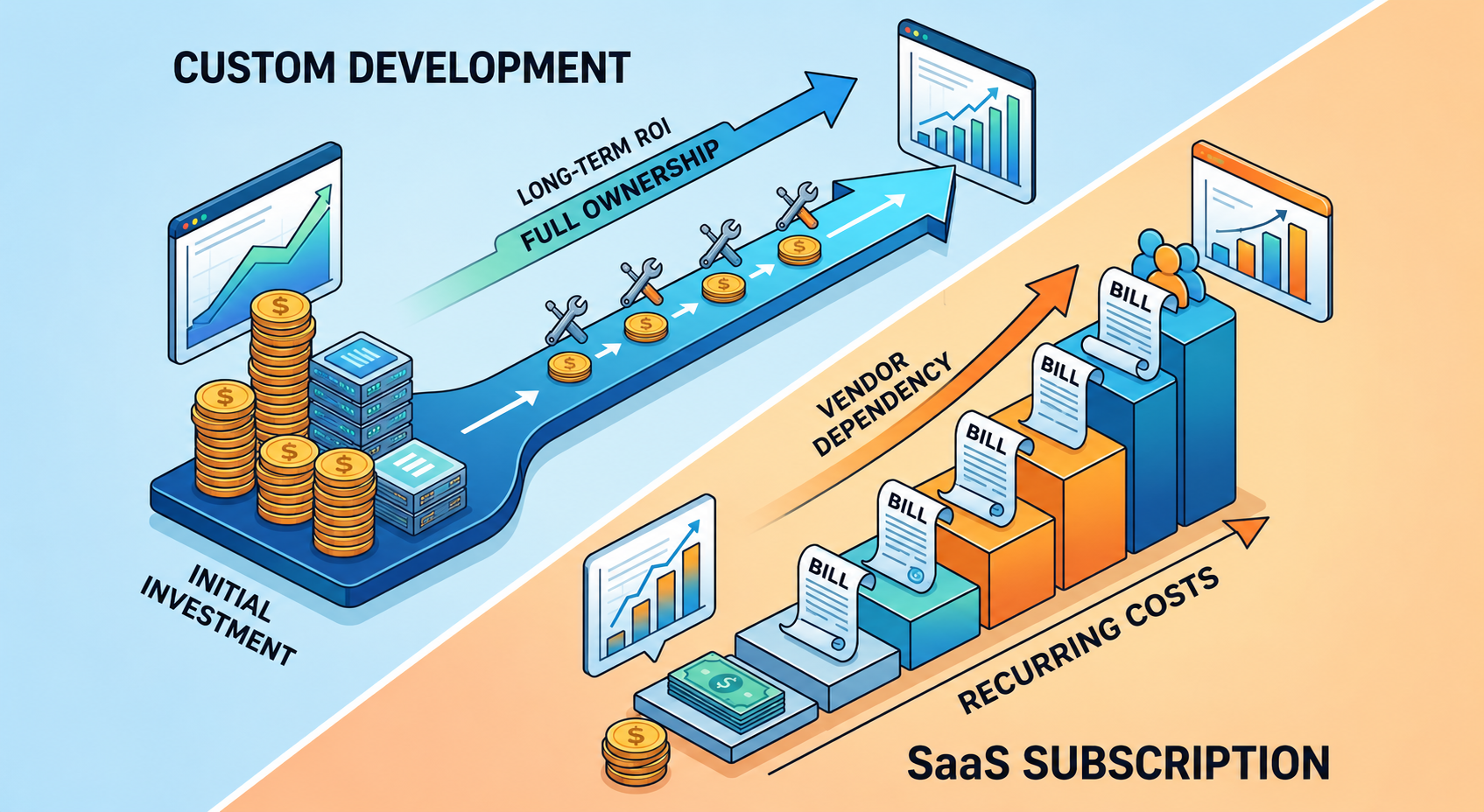
Custom Software vs SaaS: Quick Comparison
When comparing custom software and SaaS, the primary differences come down to ownership, customization limitations, upfront costs versus recurring costs, and the speed of initial deployment.
| Feature | Custom Software | SaaS |
|---|---|---|
| Initial Cost | Higher upfront investment | Low setup fees |
| Recurring Cost | Low (maintenance only) | High (monthly/annual subscriptions) |
| Customization | 100% Unlimited | Highly restricted |
| Ownership | You own the IP & source code | Vendor retains all ownership |
| Scalability | Architected for infinite scaling | Restricted by subscription tiers |
| Security | Full data isolation & control | Shared multi-tenant databases |
Deep Dive: Cost Comparison Over Time
Over a 3-to-5 year timeline, custom software is generally more cost-effective than SaaS for medium-to-large teams, as it completely eliminates compounding monthly per-user licensing fees.
SaaS Pricing Limitations
SaaS appears cheaper initially but utilizes a pay-per-user or pay-per-feature model. As your company hires more employees or requires advanced features, SaaS costs scale linearly and often become prohibitively expensive.
Customization & Scalability Factors
Custom software scales infinitely without arbitrary paywalls, allowing organizations to build workflows, dashboards, and automated triggers exactly as required. Conversely, scaling SaaS typically requires purchasing enterprise-tier subscription plans.
Security, Compliance, and Integrations
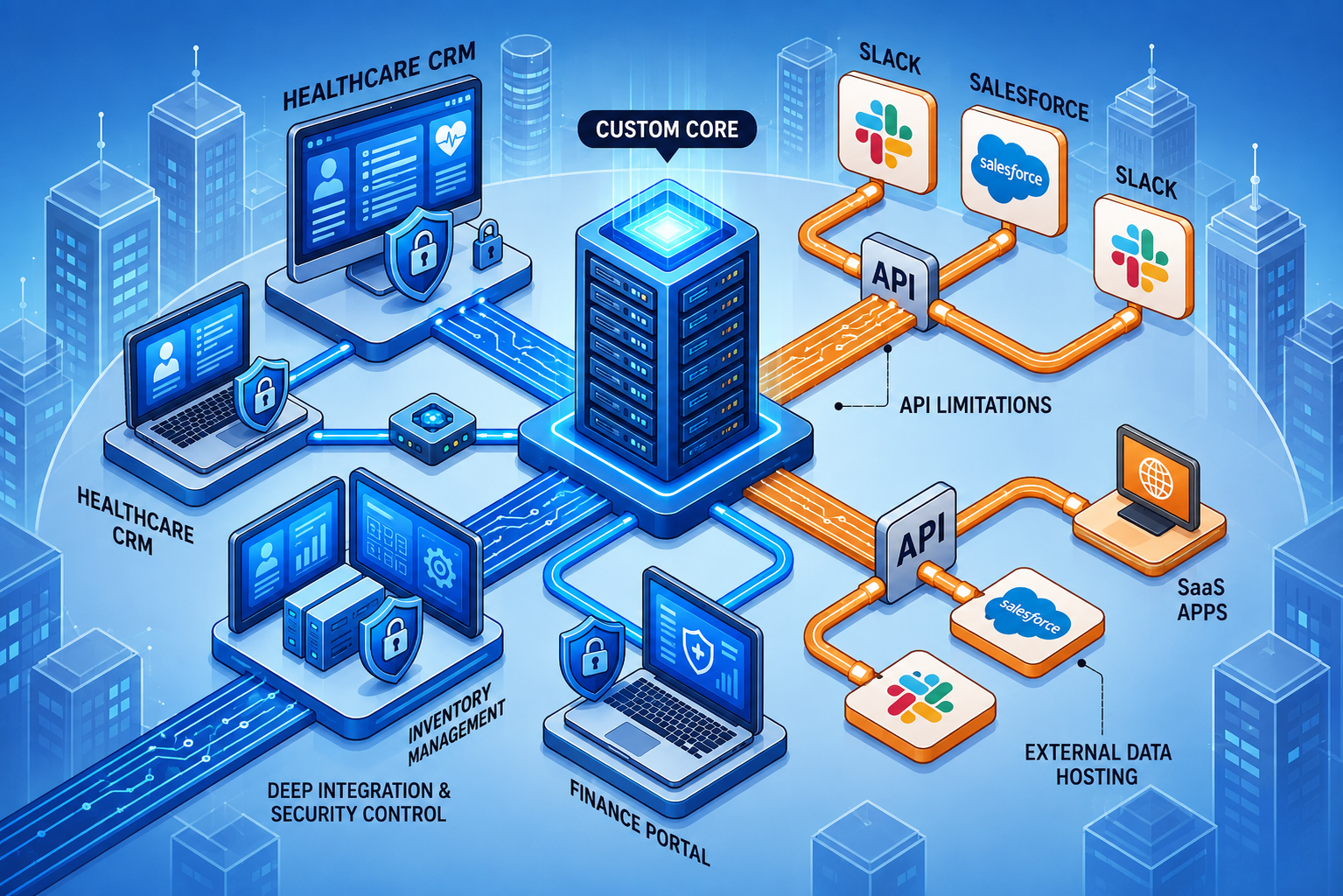
Security Architectures Compared
Custom software provides absolute control over data sovereignty, allowing businesses to dictate where data is hosted, how it is encrypted, and ensuring strict compliance with regulations like HIPAA or GDPR.
While reputable SaaS vendors invest heavily in security, their multi-tenant architectures mean your proprietary data sits in the same database alongside their other clients' data.
When Should You Choose SaaS?
SaaS is the best choice when you need a software solution immediately, your operational processes are highly standardized across your industry, and you have a limited upfront IT budget.
When Should You Choose Custom Software?
Custom software is the right choice when your business utilizes proprietary workflows that act as a competitive advantage, you require complex integrations with legacy systems, or you want to avoid expensive, compounding monthly per-user subscription fees.
Ready to translate these insights into real operational efficiency?
Let's design and build your custom web applications, SaaS dashboards, or CRM integrations. Reach out to our solutions architect desk for a free feasibility review.
Frequently Asked Questions
Custom software requires a higher initial investment for development, but it often becomes significantly cheaper over a 3-to-5 year period by eliminating monthly per-user licensing fees.
A standard custom software application takes between 3 to 6 months to develop and deploy, whereas a SaaS application can be set up in a matter of hours or days.
Yes, many businesses start with a SaaS product to validate their processes and then migrate to custom software when the SaaS subscription costs become too high or their processes outgrow the SaaS limitations.