AI Agent vs Agentic AI: What’s the Difference and Which One Does Your Business Need?
Understand the difference between AI agents and agentic AI, including their capabilities, architecture, use cases, benefits, and how businesses can choose the right AI approach for automation and digital transformation.

Sai Sabiksha
Founder
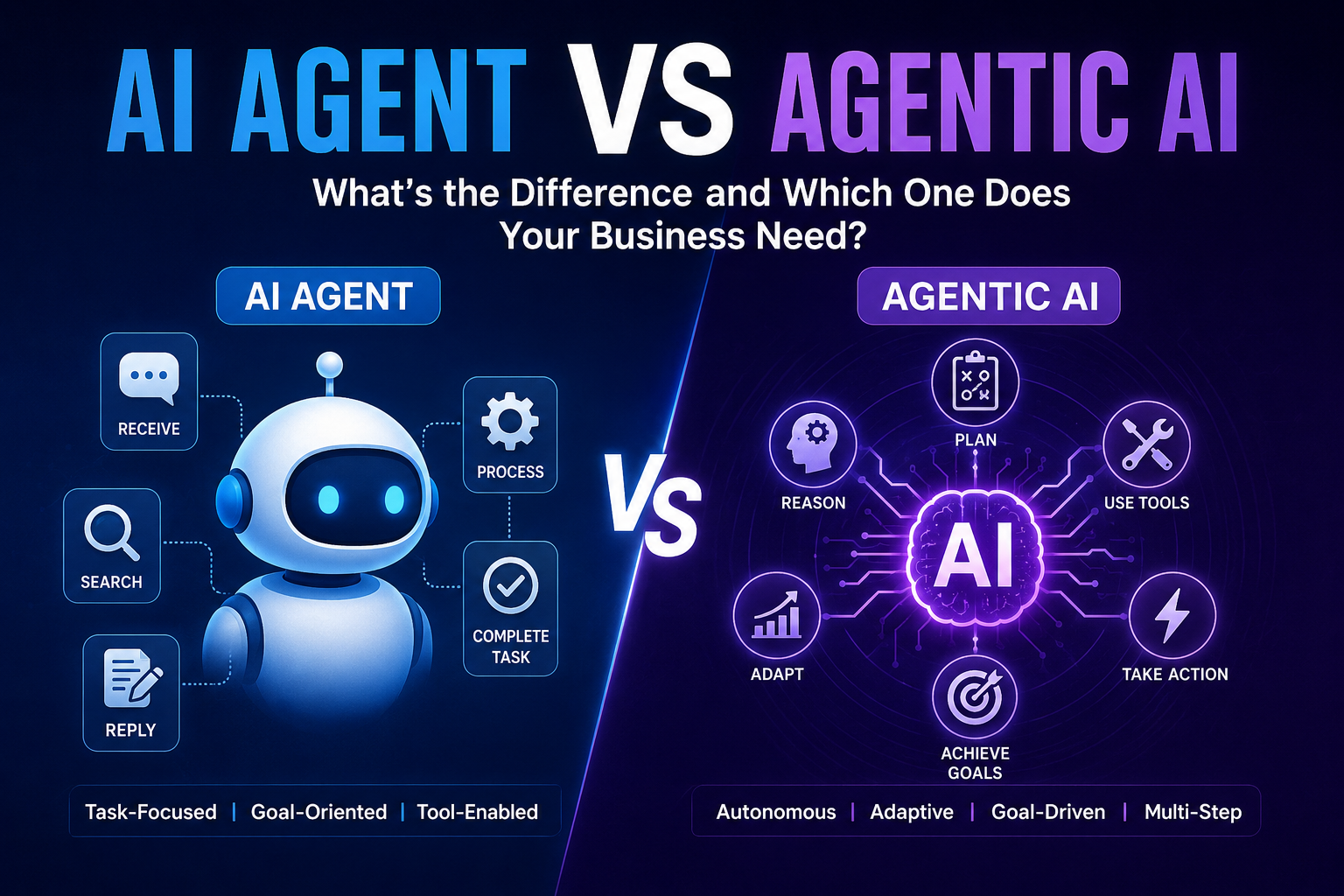
Artificial intelligence is moving beyond simple chatbots and question-answering systems. Businesses are increasingly adopting AI systems that can understand goals, make decisions, use tools, and complete tasks with less human intervention. Two terms that frequently appear in this space are AI agents and agentic AI.
Although these terms are closely related, they are not exactly the same. An AI agent is generally a system designed to perform specific tasks based on instructions, while agentic AI describes a broader capability where AI systems can pursue goals, reason through multiple steps, adapt to changing conditions, and take actions autonomously.
Understanding the difference between AI agents vs agentic AI can help businesses decide whether they need a task-focused AI assistant, a multi-step automation system, or a more autonomous AI architecture.
What Is an AI Agent?
An AI agent is a software system that can perceive information, process it, make decisions, and perform actions to achieve a defined objective.
Unlike a traditional chatbot that simply generates a response to a prompt, an AI agent can interact with external tools, applications, databases, APIs, or business systems.
For example, a customer-support AI agent could read a customer's message, identify the problem, search a knowledge base, retrieve account information, create a support ticket, send a response, and escalate the issue to a human employee when necessary.
How Does an AI Agent Work?
A typical AI agent operates through several components that allow it to understand information, reason about a task, use available tools, and execute actions.
1. Input and Perception
The agent receives information from users, applications, documents, sensors, databases, or APIs.
2. Reasoning
The AI analyzes the available information and determines what needs to happen next.
3. Planning
For more complex tasks, the agent can break a goal into smaller steps.
4. Tool Usage
The agent can interact with external tools such as APIs, databases, search systems, CRM platforms, or business applications.
5. Action
The agent executes the selected action and observes the result.
6. Feedback
The result can be used to determine whether the objective has been completed or whether another step is necessary.
This creates a basic loop: Observe → Reason → Plan → Act → Observe.
What Is Agentic AI?
Agentic AI refers to AI systems designed with a higher degree of autonomy, goal-directed behavior, reasoning, planning, adaptation, and action.
Instead of focusing on a single task, an agentic AI system can be designed to pursue a broader objective and determine the steps required to accomplish it.
For example, imagine a business wants to improve its online sales. An agentic AI system could analyze sales and customer data, identify products with declining performance, research customer behavior, recommend marketing strategies, generate campaign content, send approved campaigns through marketing platforms, monitor campaign performance, and adjust recommendations based on the results.
The important difference is the degree of autonomy and goal-oriented behavior.
AI Agent vs Agentic AI: Key Difference
An AI agent is an individual system capable of performing tasks and taking actions, while agentic AI describes a broader approach to building AI systems that can pursue goals through autonomous reasoning, planning, adaptation, and action.
An AI agent can therefore be considered a building block within a larger agentic AI architecture.
AI Agent vs Agentic AI Comparison
| Feature | AI Agent | Agentic AI |
|---|---|---|
| Primary purpose | Perform specific tasks | Pursue broader goals |
| Autonomy | Usually limited or controlled | Higher degree of autonomy |
| Planning | Simple to moderate | Multi-step and dynamic |
| Decision making | Task-oriented | Goal-oriented |
| Tool usage | Can use selected tools | Can coordinate multiple tools |
| Adaptation | Usually limited | Can adapt based on outcomes |
| Workflow | Often predefined | More dynamic |
| Human involvement | Often required at checkpoints | Can operate with fewer interventions |
| Complexity | Lower | Higher |
| Typical use | Support, search, automation | Complex business workflows |
Are AI Agents and Agentic AI the Same?
No. They are related, but they describe different levels of AI capability.
An AI agent is usually a specific system that performs tasks or takes actions. Agentic AI is a broader concept describing AI systems that demonstrate agent-like characteristics such as autonomy, planning, reasoning, memory, tool use, goal pursuit, and adaptation.
A useful analogy is: AI agent = individual worker. Agentic AI = intelligent system that can organize and coordinate work toward a goal.
Examples of AI Agents
AI agents are already useful in many business workflows where clearly defined tasks can be automated.
Customer Support Agent
A customer support agent can answer questions, retrieve customer information, create tickets, and route complex cases.
Sales Agent
A sales agent can qualify leads, update CRM records, schedule meetings, and generate follow-up messages.
IT Support Agent
An IT agent can diagnose common technical problems, retrieve system information, and guide employees through troubleshooting.
Research Agent
A research-focused agent can collect information from approved sources, summarize findings, and prepare reports.
Finance Agent
A finance agent can assist with invoice processing, financial data retrieval, reconciliation workflows, and reporting.
Examples of Agentic AI
Agentic AI becomes more valuable when a business objective requires multiple connected tasks and dynamic decision making.
Autonomous Business Research
An agentic system could receive a goal such as analyzing competitors and identifying opportunities for a new product. The system could determine which research tasks are required, collect information, compare findings, generate insights, and prepare a report.
Marketing Optimization
An agentic AI workflow could monitor campaign performance, identify underperforming campaigns, analyze possible causes, and recommend optimization actions.
Enterprise Operations
An agentic system could coordinate information from CRM, ERP, analytics, support, and project-management systems to identify operational issues and recommend actions.
Core Components of Agentic AI
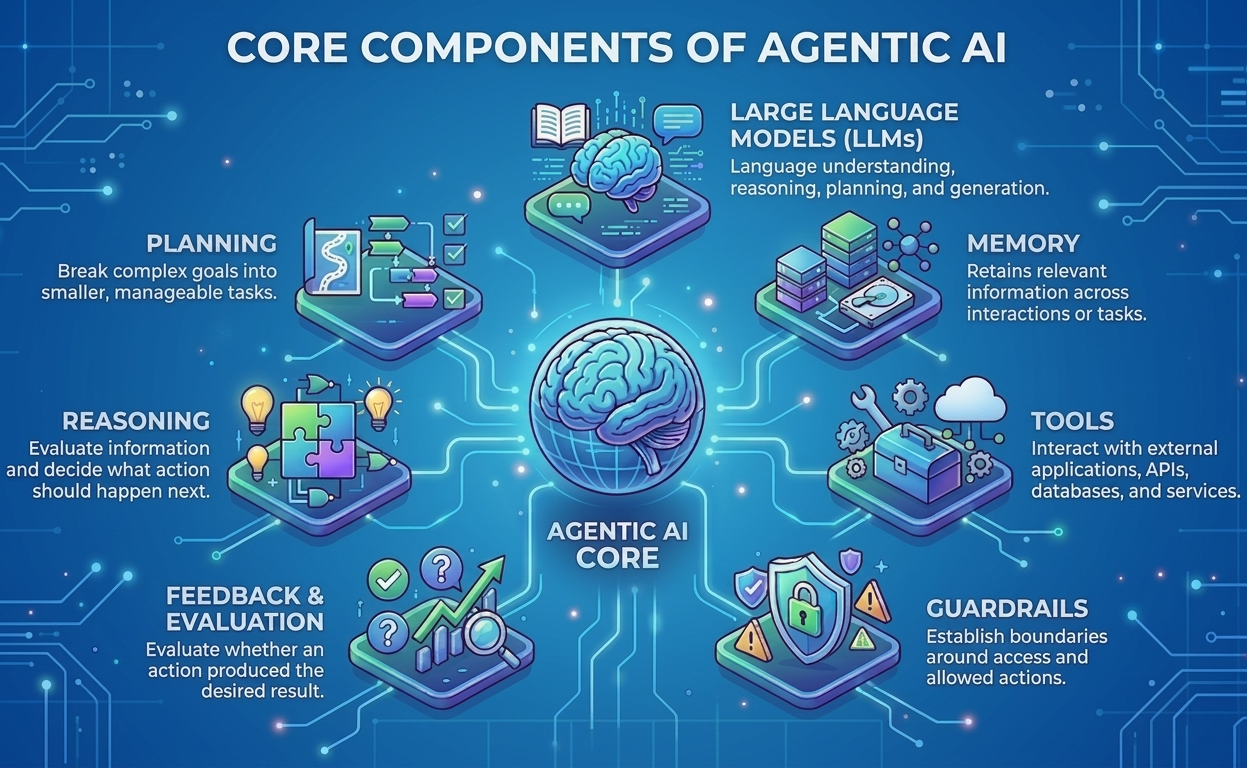
Core Components of Agentic AI
Agentic AI systems commonly combine several capabilities to support autonomous and goal-oriented workflows.
- Large Language Models: Provide language understanding, reasoning, planning, and generation capabilities.
- Memory: Allows AI systems to retain relevant information across interactions or tasks.
- Tools: Allow AI systems to interact with external applications, APIs, databases, search systems, and other services.
- Planning: Enables an AI system to break complex goals into smaller tasks.
- Reasoning: Helps the system evaluate information and decide what action should happen next.
- Feedback and Evaluation: Helps the system evaluate whether an action produced the desired result.
- Guardrails: Establish boundaries around what the AI can access and what actions it is allowed to perform.
Benefits of AI Agents for Businesses
Automate Repetitive Work
Agents can handle repetitive tasks that would otherwise require employees to manually perform the same operations.
Improve Response Times
Connect Business Systems
Agents can interact with APIs and enterprise systems, reducing the need for employees to move information manually between applications.
Improve Productivity
Employees can focus on higher-value activities while AI handles routine operations.
Provide 24/7 Assistance
AI agents can operate outside traditional business hours, providing continuous support.
Benefits of Agentic AI
Goal-Oriented Automation
Instead of specifying every individual action, businesses can define a broader objective and allow the system to determine appropriate steps.
Multi-Step Workflows
Agentic systems can coordinate multiple actions across different applications.
Dynamic Decision Making
The system can adapt its next action based on new information and previous results.
Reduced Manual Coordination
Multiple systems and processes can potentially be coordinated automatically.
Scalable Digital Operations
Agentic architectures can support increasingly sophisticated AI-driven workflows as business requirements evolve.
When Should a Business Use an AI Agent?
An AI agent is often the better choice when the task is clearly defined, the workflow is relatively predictable, the agent needs access to a limited set of tools, human approval is required at important checkpoints, and the workflow has clear success criteria.
- The task is clearly defined.
- The workflow is relatively predictable.
- The agent needs access to a limited set of tools.
- Human approval is required for important actions.
- The business wants a controlled automation solution.
- The workflow has clear success criteria.
For example, a customer-support agent that answers FAQs and creates tickets can be implemented without building a highly autonomous agentic architecture.
When Should a Business Use Agentic AI?
Agentic AI may be more appropriate when the objective is broader than a single task and multiple systems need to be coordinated.
- The objective is broader than a single task.
- Multiple systems need to be coordinated.
- The workflow contains multiple decision points.
- The environment changes frequently.
- The AI needs to plan dynamically.
- The system needs to evaluate results and determine subsequent actions.
However, greater autonomy also creates greater technical, security, governance, and monitoring requirements.
AI Agent vs Agentic AI: Which Is Better?
There is no universal winner. The right choice depends on the business problem.
If an organization needs a controlled system for a specific workflow, an AI agent may be sufficient. If an organization wants AI to coordinate complex, multi-step objectives with greater autonomy, agentic AI may provide more value.
The best strategy is to start with the simplest architecture that can reliably solve the business problem.
How Businesses Can Start With Agentic AI
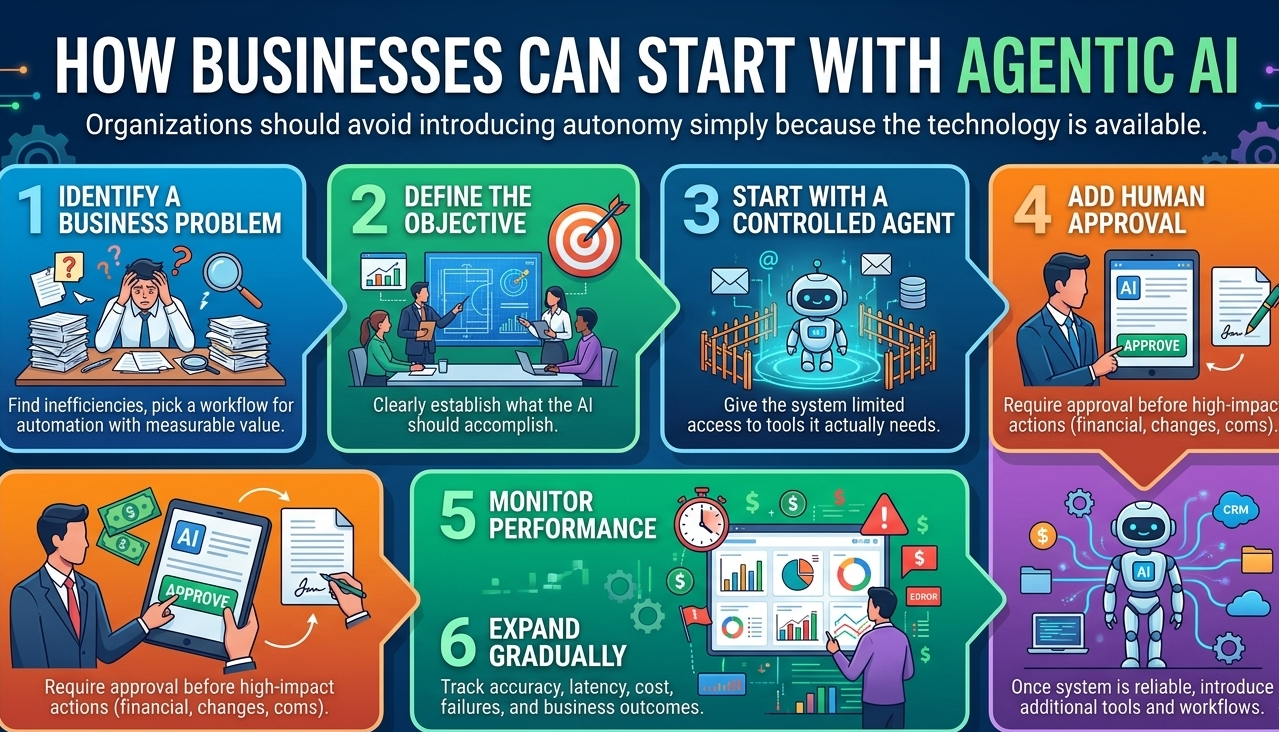
How Businesses Can Start With Agentic AI
Step 1: Identify a Business Problem
Choose a workflow where automation can produce measurable value.
Step 2: Define the Objective
Clearly establish what the AI should accomplish.
Step 3: Start With a Controlled Agent
Give the system limited access to the tools it actually needs.
Step 4: Add Human Approval
Require approval before high-impact actions such as financial transactions, customer account changes, or sensitive communications.
Step 5: Monitor Performance
Track accuracy, latency, cost, failures, and business outcomes.
Step 6: Expand Gradually
Once the system is reliable, additional tools and workflows can be introduced.
Security and Governance Considerations
Greater AI autonomy also means greater responsibility. Businesses should establish controls around data access, authentication, authorization, API permissions, sensitive information, human approval, audit logs, prompt injection risks, tool misuse, model errors, monitoring, and evaluation.
- Data access
- Authentication
- Authorization
- API permissions
- Sensitive information
- Human approval
- Audit logs
- Prompt injection risks
- Tool misuse
- Model errors
- Monitoring and evaluation
An AI system should not receive unrestricted access to critical business systems simply because it can technically interact with them.
A strong agentic architecture should follow the principle of least privilege, giving each AI component only the permissions necessary to perform its assigned tasks.
The Future of AI Agents and Agentic AI
The future of enterprise AI is likely to involve a combination of traditional automation, AI agents, and increasingly agentic systems.
Businesses will not necessarily replace every workflow with autonomous AI. Instead, organizations are likely to create hybrid systems where AI handles routine tasks, agents coordinate specific workflows, and humans remain responsible for important decisions.
This approach provides a balance between automation, control, reliability, and business value.
Final Thoughts
The debate between AI agent vs agentic AI is ultimately less about choosing one technology and more about choosing the right level of autonomy for a specific business problem.
AI agents are powerful tools for task-oriented automation. Agentic AI extends these capabilities toward goal-oriented systems that can plan, reason, use tools, adapt, and coordinate multiple steps.
For businesses exploring AI transformation, the most important question is not whether they should use agentic AI. Instead, businesses should ask what outcome they want AI to achieve and what level of autonomy is appropriate.
Starting with a clearly defined use case, controlled permissions, measurable outcomes, and strong governance can help organizations build AI systems that deliver practical value without unnecessary complexity.
Ready to translate these insights into real operational efficiency?
Let's design and build your custom web applications, SaaS dashboards, or CRM integrations. Reach out to our solutions architect desk for a free feasibility review.
Frequently Asked Questions
An AI agent is a software system that can perceive information, reason about a task, use available tools, and take actions to achieve a defined objective.
Agentic AI refers to AI systems designed with greater autonomy, goal-directed behavior, reasoning, planning, adaptation, memory, tool usage, and the ability to take actions toward broader objectives.
An AI agent is generally a task-focused system capable of taking actions, while agentic AI describes a broader approach in which AI systems can pursue goals through planning, reasoning, tool use, adaptation, and greater autonomy.
No. They are closely related but are not exactly the same. AI agents can be building blocks within larger agentic AI systems, while agentic AI describes a broader level of autonomous and goal-oriented behavior.
Businesses should consider an AI agent when they have a clearly defined, relatively predictable workflow that can be automated using a controlled set of tools and clear success criteria.
Agentic AI can be useful when a business needs AI to pursue broader objectives, coordinate multiple systems, perform multi-step planning, make dynamic decisions, and adapt based on results.
Agentic AI can provide a higher degree of autonomy and handle more complex workflows, but greater autonomy also introduces additional security, governance, monitoring, and reliability requirements.
Businesses can start with a clearly defined use case, limit AI permissions, use human approval for high-impact actions, monitor performance, implement security controls, and gradually expand the system as reliability improves.